
How AviClear® works.
If you're the kind of person who wants to understand why a treatment should work before you book it — this page is for you. Here's the biology of acne, and how AviClear®'s specific wavelength of light is designed to interrupt it at the source.
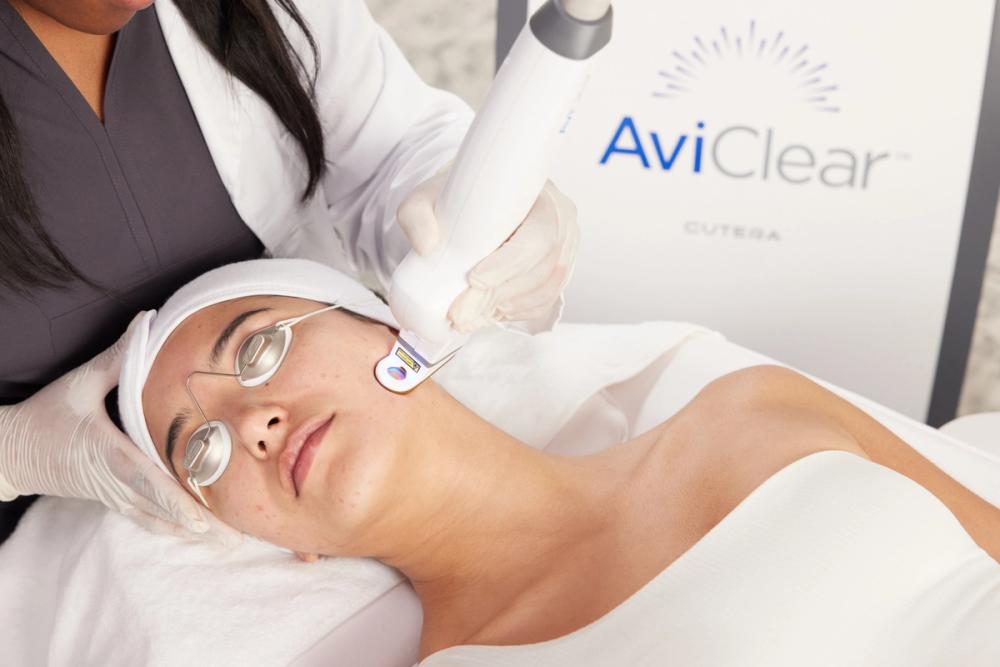
Start with what's actually happening in your skin.
Acne isn’t a hygiene problem or a moral failing — it’s biology. Three things drive most breakouts, and they tend to happen in sequence:
Your sebaceous glands
Tucked at the base of each hair follicle, these glands produce sebum — the oil that normally keeps skin lubricated. In acne-prone skin, they produce too much.
A clogged follicle
When excess sebum mixes with dead skin cells, it can block the follicle, creating the plug we call a comedone — a blackhead or whitehead.
Bacteria & inflammation
C. acnes, a bacteria that normally lives on skin, thrives in that trapped, oil-rich environment. As it multiplies, the body responds with inflammation.
Healthy follicle
Oil flows freely from the gland up to the surface.
Excess sebum
The gland swells and oil starts to build up inside.
Clogged follicle
Oil and dead cells form a plug that seals the opening.
Bacteria & inflammation
Trapped bacteria multiply and the area reddens and swells.
- Sebum (oil)
- Dead skin cells
- C. acnes bacteria
- Inflammation
The thread running through all of it is sebum. The sebaceous gland is upstream of nearly everything else — which is exactly where AviClear® aims.
A drug-free option, chosen on purpose.
Plenty of patients arrive at Clarity tired of the same loop: a new prescription, a new product, a few good weeks, then the breakouts return. We chose AviClear® because it gives us a way to treat acne that doesn’t depend on remembering a daily medication or managing the side effects that come with some oral options.
It isn’t right for everyone, and we’ll tell you if it isn’t right for you. But for the right patient, it’s a focused, light-based path that fits into a real schedule — short visits, no downtime built around it, and a clear plan from the first appointment.
Not just "a laser" — a specific one.
AviClear® uses a 1726 nm wavelength. That number is the whole point. Light at 1726 nm is preferentially absorbed by the lipids (oils) concentrated in the sebaceous glands, which lets the energy reach and act on the glands selectively — while contact cooling helps protect the skin’s surface above.
Selective targeting
Because the wavelength is drawn to the glands themselves, the treatment can act where acne originates rather than only on the surface.
Melanin-safe across skin tones
The 1726 nm wavelength isn’t strongly absorbed by melanin, which is why AviClear® is designed to be used safely across the full range of skin tones — a meaningful difference from some older laser approaches.
What the energy actually does.
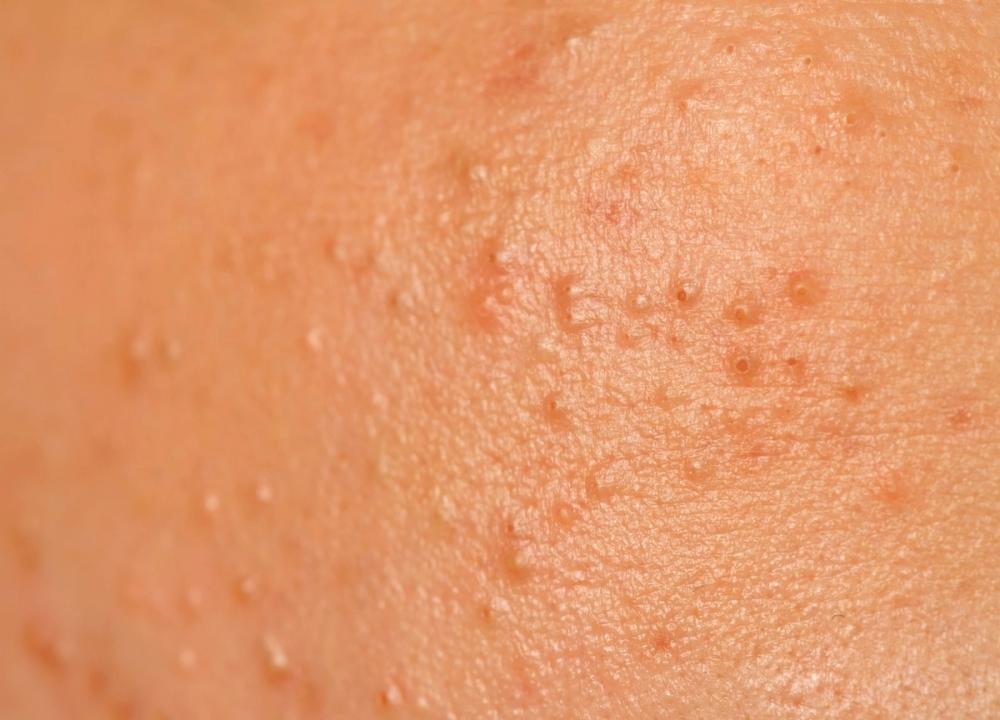
Reducing the gland
The primary mechanism. The absorbed energy gently heats the sebaceous glands, which can reduce their oil production over a series of treatments. Less excess sebum means the upstream condition that lets breakouts form is dialed back. This is AviClear®’s established, manufacturer-supported mechanism.
Changing the environment for bacteria
An indirect effect. AviClear® is not an antibiotic and doesn’t "kill acne bacteria" directly — its action is on the gland. By reducing the oil-rich environment C. acnes depends on, the conditions that let it overgrow become less favorable.
Calming inflammation
A downstream result. When there’s less excess sebum and fewer clogged, bacteria-rich follicles, there’s less of the trigger that drives inflammatory breakouts — so patients may see calmer, less inflamed skin over a treatment series.
What the studies show.
AviClear® is FDA-cleared as a long-term treatment for mild-to-severe inflammatory acne vulgaris — first cleared in 2022, with a later clearance recognizing long-term effectiveness.
In a prospective, multicenter study published in the Journal of the American Academy of Dermatology (2025), 104 patients with moderate-to-severe facial acne, spanning Fitzpatrick skin types II–VI, received three AviClear® (1726 nm) treatments and were then followed for a full year.
Lesion reduction that held up over time
The share of patients achieving at least a 50% reduction in inflammatory lesions rose from 79.8% at 12 weeks to 91.5% at one year (95% CI 83–97%; P < .001).
More patients reaching “clear” or “almost clear”
On the Investigator’s Global Assessment, the share rated clear or almost clear rose from about 36% at three months to 66.2% at one year.
Consistent response across skin tones
Response rates stayed above 85% across every subgroup studied — age, sex, acne severity, and Fitzpatrick skin type — consistent with AviClear®’s design for use across a range of skin tones.
A mild, transient side-effect profile
The most common effects were mild redness (all patients) and mild swelling (98.1%), which settled on their own. No blistering, scarring, or pigment changes were reported through one year; a temporary “purge” is possible but generally mild and self-resolving.
Source: Goldberg D, Ronan S, Bhatia A, et al. Safe and effective acne treatment across skin types with a 1726 nm sebum-selective laser: one year data from a prospective multicenter study. J Am Acad Dermatol. 2025;94(2).
How this differs from creams and washes.
Topical treatments — over-the-counter or prescription — generally work at or near the skin’s surface and need to be applied consistently, often indefinitely, to keep working. They help many people, and for some they’re enough.
AviClear® takes a different route: instead of a product you apply daily, it acts on the sebaceous gland itself over a short series of in-clinic sessions. It’s not "better than topicals" for everyone — it’s a different approach, suited to patients who haven’t gotten where they want with topical routines, who’d rather not manage a daily regimen, or who want to address the gland rather than the surface.
The right answer depends on your skin, and that’s a conversation for your consultation.
Curious whether the science fits your skin?
The biology explains how AviClear® is designed to work. Whether it's right for you is what a consultation is for.